

Article
Food Import Documents: What to Request from Your Overseas Supplier
Upturn Global Logistics Team
Published October 15, 2026
Updated October 16, 2026
A practical supplier-document checklist for Philippine food importers, from invoices and packing lists to product details and category-specific certificates.
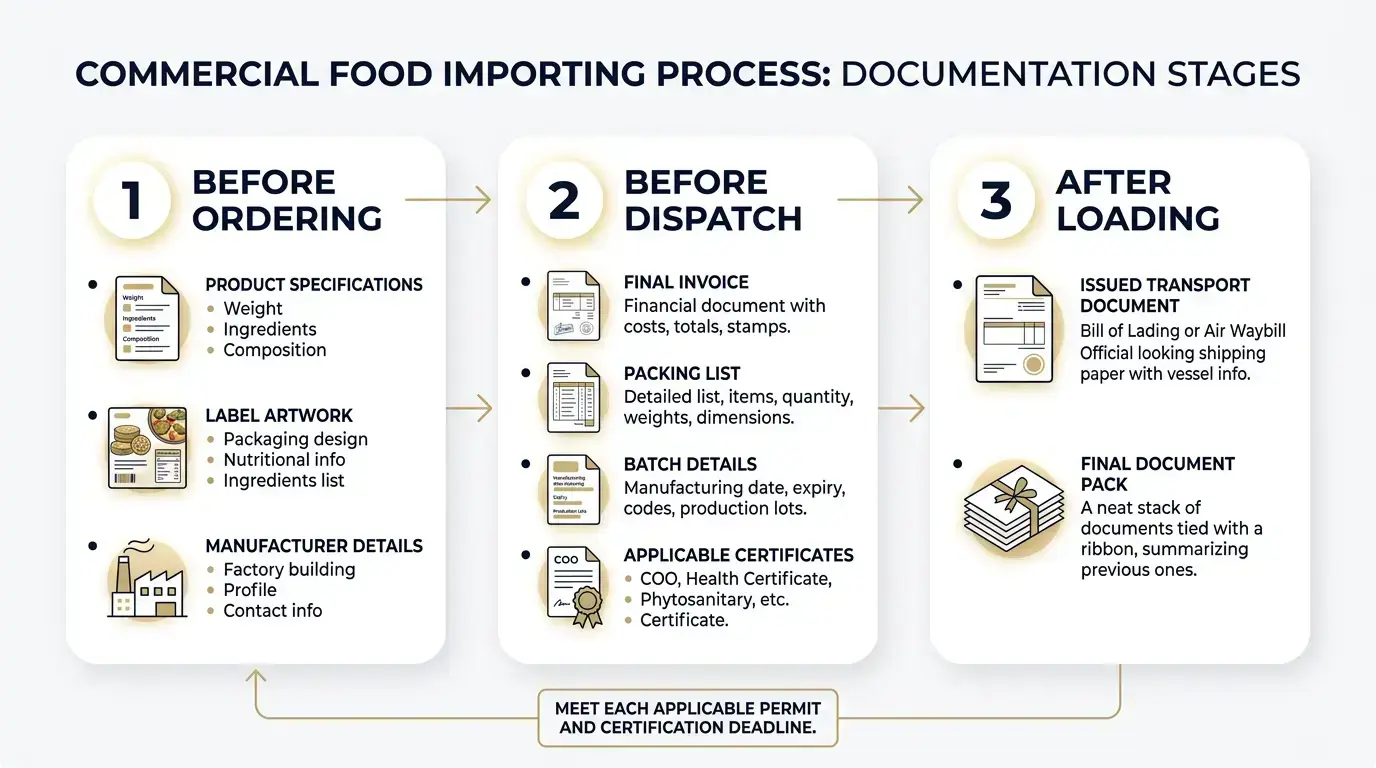
Before your supplier ships food to the Philippines, ask for a draft commercial invoice, packing details, product specifications, label artwork, and the manufacturer’s information. Then confirm which certificates apply to the actual product and origin. Agree who will arrange each document and when you will receive it.
“We will send the documents after loading” leaves little room to fix a wrong consignee, an unclear product description, or a missing certificate. Ask for drafts while there is still time to change the paperwork and, if needed, the order.
This guide is for commercial food imports. It separates the information you request from your overseas supplier from the authorizations your Philippine importing business must arrange. A supplier’s export documents do not establish that the product is cleared for import here.
Food import documents at a glance
Request | Who provides or arranges it | When to review |
Draft commercial invoice and packing details | Supplier; final packing list follows actual packing | Before booking, then reconcile final quantities |
Product specifications, ingredients, and label artwork | Manufacturer, often through the supplier | Before committing to the product or printing labels |
Batch, date, and storage information | Manufacturer or supplier | Agree requirements before ordering; check actual batches before dispatch |
Bill of lading or air waybill details | Carrier or forwarder; supplier coordinates where responsible | Check shipping instructions or draft before issuance |
Health, veterinary, or phytosanitary certificate, where applicable | Relevant authority in the exporting country, arranged through the exporter | Confirm requirements early and meet the applicable certification deadlines |
Certificate of origin or other accepted proof of origin, where applicable | Exporter or authorized issuing body under the relevant rules | Confirm the required form before shipment |
Analysis reports and supporting product certificates, where applicable | Manufacturer, laboratory, or relevant issuing body | Confirm scope before ordering; obtain batch evidence where needed |
The Bureau of Customs lists the core shipment records in its Guidelines on Importation. Treat the table above as a supplier coordination checklist. The exact submission requirements depend on the goods and the applicable agency rules.
Start with the product, manufacturer, and country of origin
Give your customs broker and regulatory contact enough information to identify the goods. “Food products” is too broad. Frozen raw chicken, bottled sauce, and fresh apples need different checks even if they come from the same supplier.
Product name, brand, variant, ingredients, and intended use: retail sale, further processing, or another purpose.
Processing method and condition: raw, cooked, dried, canned, frozen, or otherwise prepared.
Actual manufacturer’s legal name and production-site address, as well as the seller’s details.
Country of production and country of dispatch; these may differ.
Retail pack sizes, units per carton, expected quantities, and storage conditions.
Ask who can obtain official certificates and answer technical questions. A trading company may need to go back to the factory for ingredients, test results, or label files. Establish that contact before placing the order.
Check the invoice and packing list together
Ask for a draft invoice that identifies each product clearly, with its pack size, quantity, unit price, currency, and total value. Confirm the buyer and consignee details with your Philippine team. Record the agreed Incoterm and named place so everyone understands the commercial arrangement.
The packing list should explain how the order is packed: cartons, units per carton, net and gross weights, dimensions, and shipping marks. For mixed products or batches, ask for a breakdown that lets you trace each item to its cartons or pallets.
For example, an invoice might show 1,200 jars while the packing list shows 100 cartons. That can be correct if each carton contains 12 jars. The problem is leaving that relationship unexplained. Check the arithmetic and units before approving the final versions.
Use the draft or pro forma invoice for planning, then obtain the final commercial invoice reflecting the transaction. Keep the purchase order, payment evidence, and any freight or insurance records your broker needs. Resolve genuine differences with the issuer rather than editing documents yourself.
For the wider cost calculation, see How to Calculate Import Duties and Taxes in the Philippines.
Get product specifications and readable label files
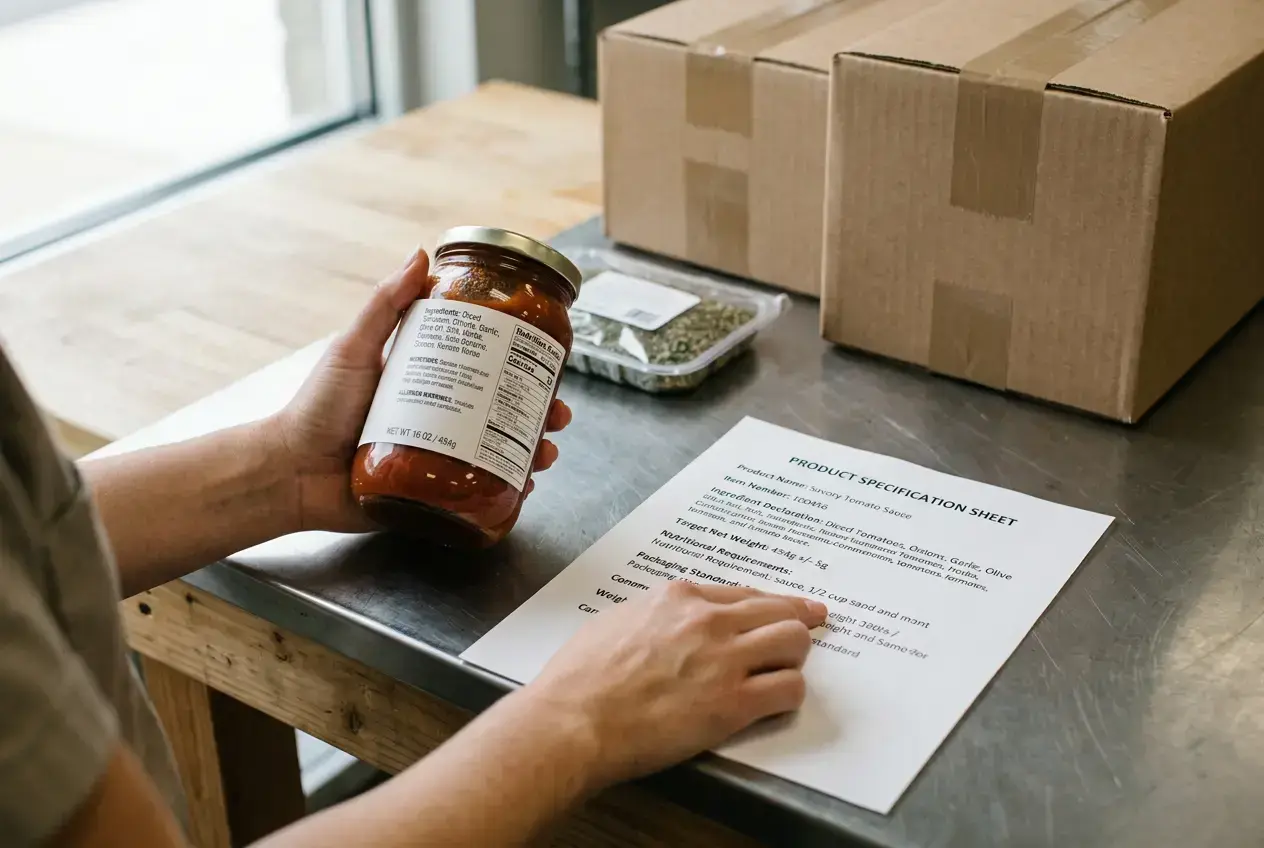
A photograph of the front of a packet is rarely enough for a useful review. Request clear images of every panel and the artwork file, along with the ingredient list, allergen information, product specification, storage instructions, and pack sizes.
Check that the documents describe the version you are buying. A manufacturer may sell the same brand with different recipes, labels, or pack sizes in different markets. Ask the supplier to flag changes before producing your order.
For processed food, review the applicable licensing and product-registration services in the FDA food Citizen’s Charter. Supporting material can include label artwork and product photographs; the required evidence depends on the application and product. Confirm the current checklist before submission.
Where a label makes a claim such as organic, halal, or a nutritional claim, ask for the supporting evidence and have the proposed Philippine label reviewed. A logo on the supplier’s brochure is not enough to establish that the claim is suitable for your product and market.
Confirm which official certificates apply
Do not ask the supplier for “all food certificates” without identifying the requirement. Ask your Philippine regulatory contact which document is needed, who must issue it, what it must cover, and whether an original or an accepted electronic version is required.
Plant products
For goods subject to plant quarantine, the BPI National Plant Quarantine Services Division’s import guidance distinguishes the Philippine import clearance from the phytosanitary certificate issued in the exporting country. Send the applicable clearance conditions to the supplier so its export team can arrange the required certification.
Check the commodity and country combination before ordering. Do not assume that every processed food containing a plant ingredient follows the same pathway as fresh produce.
Animal products and fishery products
For meat, other animal products, or fishery products, confirm the responsible agency, product coverage, source eligibility, and applicable certificate requirements before booking. Ask the supplier which competent authority will issue the required veterinary or health certificate. A factory quality report is a different document.
For fishery products, consult BFAR’s Fisheries Inspection and Quarantine Division for the relevant certification and quarantine services. Confirm the requirements for your specific product rather than relying on documents used for a different destination.
Certificates of analysis and other product evidence
A certificate of analysis reports test results for an identified sample or batch. If one is required by your application, permit, or buyer specification, agree the parameters and acceptable issuer before production. Check the product identity, batch reference, test dates, methods, and results against the shipment or application it supports.
A certificate of free sale, food-safety certification, and a certificate of analysis serve different purposes. Request each only where it applies, and confirm the issuing body and scope. Collecting a thick folder of certificates does not resolve a missing required document.
Ask about origin documents before relying on a lower duty rate
If your costing assumes preferential duty under a trade agreement, ask your broker which proof of origin is accepted and whether the product qualifies. The country from which a supplier ships the goods is not necessarily their origin.
Confirm whether the exporter can provide the required certificate or declaration and supporting information. Do this before pricing the order on the assumption that a reduced rate will apply. A general statement that goods are “made locally” may not satisfy the relevant origin rules.
Agree batch dates and storage conditions in writing
Ask for the manufacturer’s shelf life and storage specification, then agree the remaining shelf life you need at dispatch and delivery. Allow for transit, clearance, distribution, and your customer’s acceptance requirements. There is no single commercial shelf-life target that suits every food shipment; check any applicable regulatory requirement separately.
Before dispatch, obtain the actual lot numbers, production dates, and best-before or expiry dates, as applicable. For mixed batches, ask for a batch-to-carton breakdown. Clear photos of date codes and outer cartons can help your receiving team check what arrives.
For temperature-sensitive goods, pass the written storage and transport requirements to the forwarder and receiving warehouse. Agree who arranges monitoring and who supplies the records. Do not choose a transport temperature simply because another frozen or chilled product used it.
Review shipping details before the transport document is issued
The carrier or forwarder issues the bill of lading or air waybill. Ask whoever controls the booking to circulate the shipping instructions or draft for review. Check the shipper, consignee, notify party where used, cargo description, package count, weights, and destination against the agreed shipment details.
Some final transport information becomes available only after loading or departure. Agree when it will be sent, who receives it, and how cargo release will be handled. For sea freight, confirm the release arrangement with the carrier or forwarder rather than assuming an emailed bill of lading is sufficient.
A supplier request you can adapt
Send a specific request once you know the proposed products. Replace the bracketed details and add the confirmed certificate requirements for your shipment:
We are preparing the Philippine import review for [products and order reference]. Before we confirm dispatch, please send the draft commercial invoice, proposed packing breakdown, manufacturer and production-site details, product specifications, ingredient and allergen information, and readable label artwork for each item.
Please confirm the country of production, pack sizes, shelf life, and storage requirements. Once the shipment batches are allocated, send the lot numbers and production and expiry or best-before dates, with a breakdown by carton or pallet where needed.
For [confirmed certificate requirements], please identify the issuing authority, the information you need from us, and the expected issue date. Let us know now if any required document cannot be supplied.
Please also confirm who will arrange the booking, circulate draft shipping details, and send final documents. Notify us before any change to the manufacturer, formulation, label, quantity, or shipment schedule. We will confirm the Philippine requirements with our regulatory contact and customs broker before dispatch.
Before you authorize dispatch
Reconcile the final product list, quantities, pack sizes, weights, and party details across the documents.
Check that the required Philippine authorizations are in place and cover the actual goods; supplier paperwork does not replace them.
Confirm that applicable export-side certificates meet the permit conditions, including timing and document format.
Resolve changes to origin, manufacturer, ingredients, labels, or batches with your regulatory contact.
Assign an owner and due date for any final document that can only be issued after loading.
Give your broker, forwarder, and receiving team the versions they need, and retain the final document pack.
If a required pre-shipment approval or certificate is missing, settle it before dispatch. An assurance that the supplier has shipped similar products elsewhere does not answer whether this shipment meets Philippine requirements.
Frequently asked questions
Is a commercial invoice enough to import food?
No. It is part of the shipment record. Packing and transport documents, applicable permits, and product-specific supporting records must also be considered. Start with the actual product and confirm the document list with your broker and regulatory contact.
Does every food shipment need a certificate of analysis?
Do not assume a blanket requirement. It may be needed for a particular product application, permit condition, or buyer specification. Confirm what must be tested and whether the report must relate to the shipment batch before asking the supplier to commission testing.
Can the overseas supplier arrange my Philippine permits?
The supplier can provide supporting information and may coordinate with your appointed representatives. That does not replace the Philippine importing entity’s responsibilities or the need for the appropriate local authorizations. Agree who applies for each approval and who holds it.
Are scanned copies acceptable?
Scans are useful for advance review. Whether they are accepted for submission or release depends on the document, agency, and carrier arrangements. Confirm the required original or electronic format early enough to arrange delivery or issuance.
Prepare your food shipment documents with Upturn
Send your product list, origin, supplier drafts, and proposed shipping date so the documentation and clearance scope can be assessed. See our Import and Export Documentation solution for the available support.
Request a customs brokerage quote and include the documents you already have, along with any questions the supplier has raised.
For the broader import process, read How to Import Goods into the Philippines.
Official guidance reviewed on October 16, 2026. Confirm current product- and origin-specific requirements before dispatch.
Related Articles


Newsletter
Stay ahead of the chain. Get our monthly whitepapers and innovation reports delivered directly.
Other Articles
 Announcement
July 23, 2026
BOC 3-Year Importer Accreditation Guide
A comprehensive guide to the Bureau of Customs importer accreditation extension, customs brokerage, customs clearance, and freight forwarding for businesses importing into the Philippines.
 Article
August 23, 2026
Port Congestion and Customs Clearance in the Philippines: An Importer’s Guide
Port congestion can delay cargo availability, container movement, inspection, trucking, and delivery. Learn how port congestion and customs clearance delays differ, what they cost, what causes them, and what importers can do before and after arrival to reduce demurrage, detention, and storage exposure in the Philippines.
 Article
July 19, 2026
Common Mistakes Importers and Exporters Make in the Philippines
Learn the most common mistakes importers and exporters make in the Philippines, from customs declaration and customs clearance errors to poor freight coordination, duties and taxes miscalculations, and weak document control.
READY TO SHIP WITH CONFIDENCE
Talk to a Logistics Specialist Today
Get expert support for customs clearance, freight forwarding, and end‑to‑end shipment coordination. We’ll help you stay compliant, avoid delays, and keep your cargo moving.
Trusted & Accredited
Our Affiliations & Certifications
Recognized and accredited by key industry and regulatory organizations to support compliant, reliable, and secure global trade.


