

Article
Does Your Business Need an Importer of Record in the Philippines?
Upturn Global Logistics Team
Published October 14, 2026
Updated October 15, 2026
Find out when your business may need an importer of record in the Philippines, how IOR differs from customs brokerage, and what to confirm before shipping.
Your business may need a third-party importer of record in the Philippines if you plan to ship commercial goods here but do not have a suitable local entity or customer willing and able to act as the importer. If your Philippine business or distributor can already fulfil that role, you may only need customs brokerage and freight support.
The decision starts with a practical question: which entity will be identified as the importer, and can it meet the requirements for this shipment? Before booking cargo, confirm that answer alongside the product, transaction, and delivery arrangements.
For Upturn’s service scope, see our Importer of Record and Exporter of Record solution. This guide explains how to decide whether that support fits your business.
What does an importer of record do?
In logistics discussions, importer of record, or IOR, describes the entity taking the importer role for a shipment. When reviewing an offer, ask for the actual legal entity that will appear as importer in the goods declaration. The service label alone does not establish its authority or suitability.
A proposed arrangement should make clear who supplies and checks shipment information, coordinates clearance, arranges payment of import charges, and maintains the supporting records. Put the allocation of work and costs in writing before dispatch.
The Bureau of Customs AMO requirements distinguish importer accreditation from customs broker registration and include separate requirements for non-regular importers. Check the applicable route and the proposed importer’s current status before proceeding.
When might your business need IOR services in the Philippines?
You are a foreign company without an established local importer
For a foreign company importing into the Philippines, identifying a willing local recipient is only the first step. A customer may be ready to receive equipment or stock but may not be prepared to take on the importer role. Discuss an IOR arrangement if neither your own local operation nor your buyer can handle it.
An IOR service may support an eligible shipment without your business establishing its own importing entity. Have the provider assess the actual goods and commercial arrangement first; this is not a blanket substitute for business registration or permission to sell every product locally.
Your customer wants delivery but cannot manage import formalities
Ask whether the customer intends to import under its own name or expects a delivery after clearance. Settle this during quotation, particularly when the overseas seller is arranging transport. A delivery address and a contact person do not resolve who will act as importer.
You are planning a project shipment or testing a new market
A limited shipment may make it useful to compare third-party IOR support with importing through an existing local buyer or your own qualified entity. Compare the full scope, document access, and commercial responsibilities rather than deciding from shipment frequency alone. Do not assume that a one-off shipment is automatically exempt from importer requirements.
When might you not need a separate IOR provider?
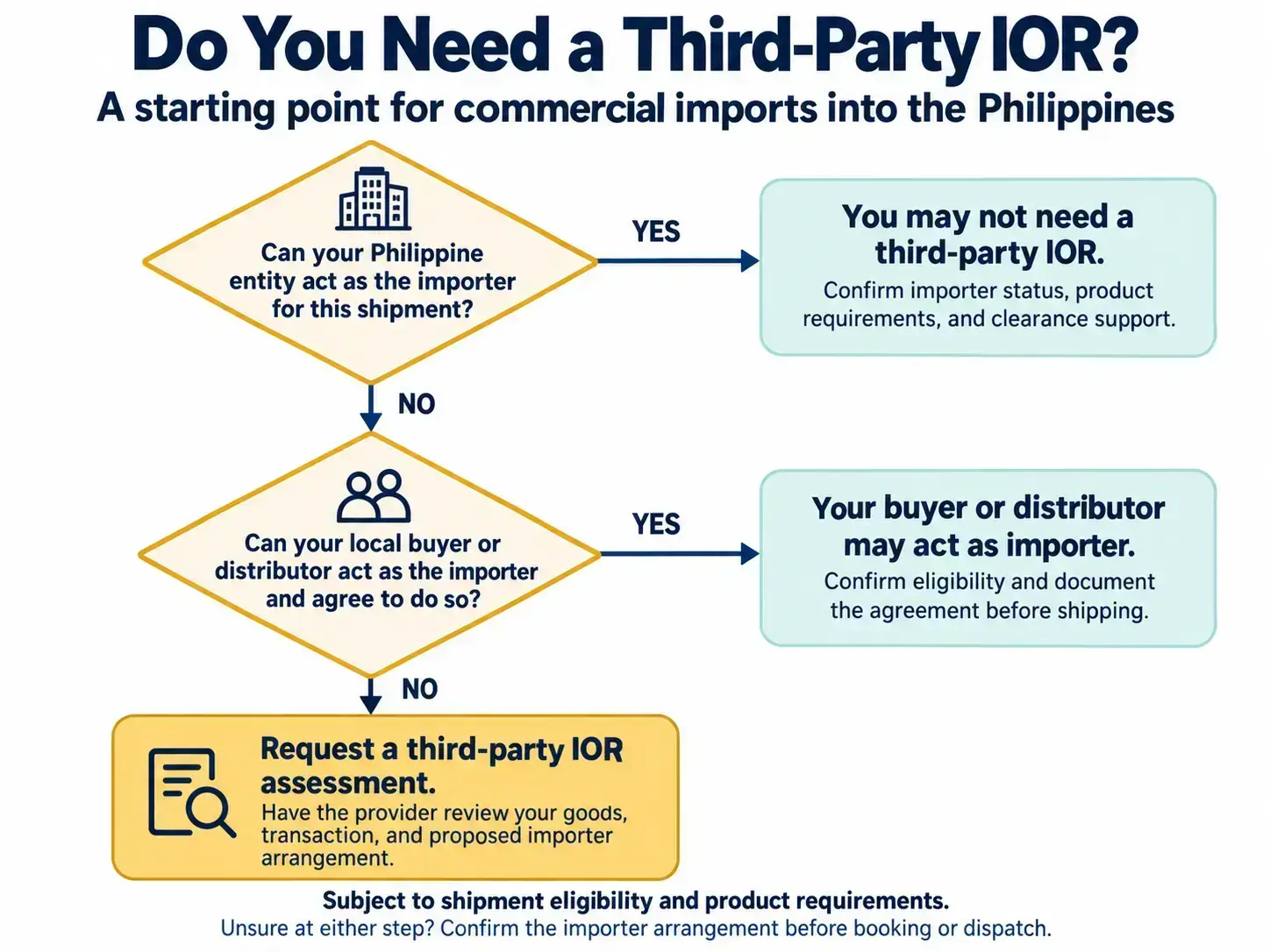
You may not need a third-party IOR if your Philippine entity already has the appropriate importer arrangements for the goods, or if a qualified local distributor has agreed to import them. In those cases, confirm whether customs brokerage, freight forwarding, and delivery are the services you actually need.
Your own local entity will import: confirm its current status, product requirements, and who will manage clearance.
Your buyer or distributor will import: document that agreement and align the shipping instructions with it.
No suitable importer has been confirmed: arrange an assessment before booking or dispatching the cargo.
Importer of record, customs broker, and freight forwarder: different roles
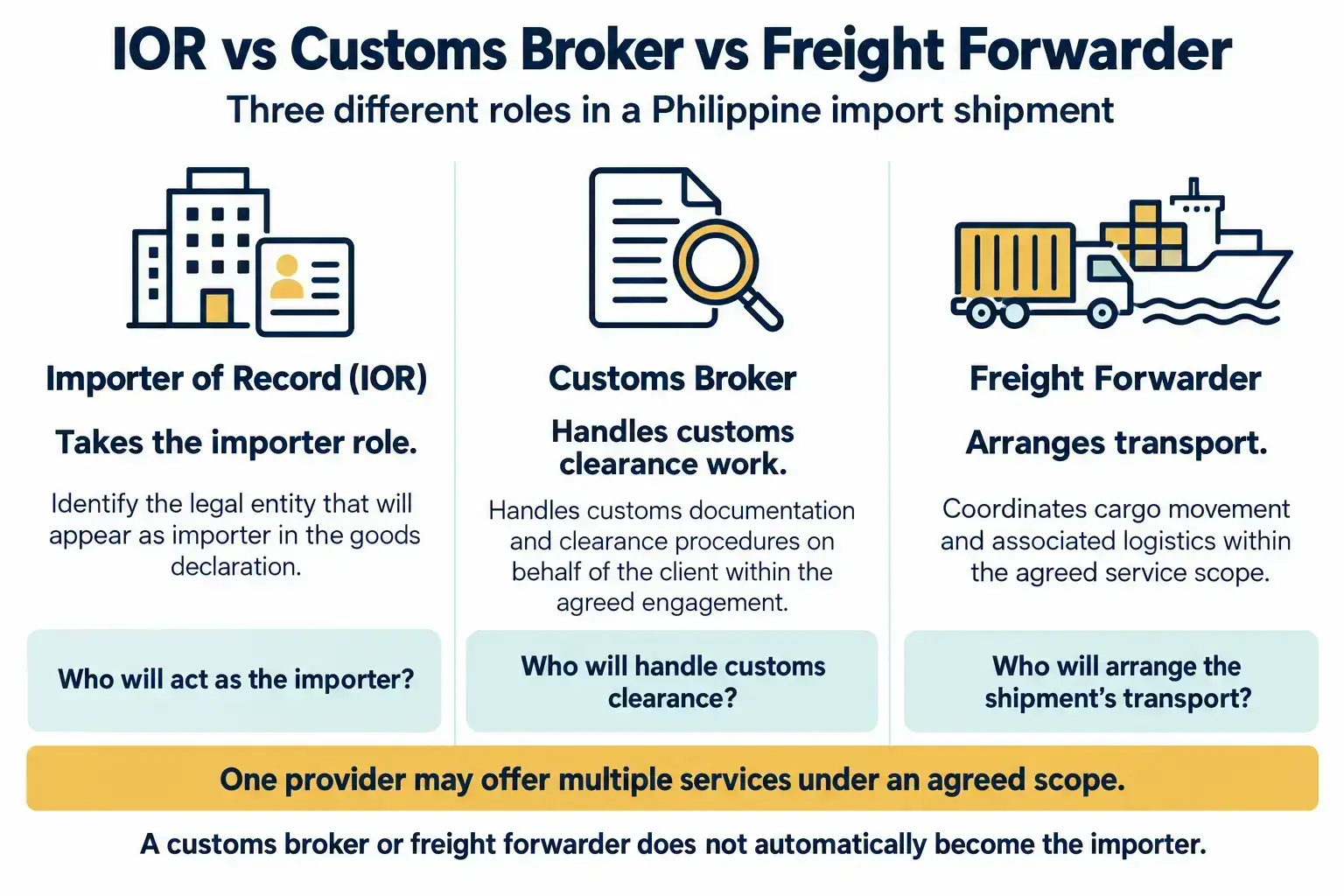
A customs broker handles customs work on behalf of the client within the agreed engagement. A freight forwarder organizes transport and associated logistics. Neither automatically becomes the importer simply by filing documents, booking freight, or advancing charges.
One provider may offer several of these services, but the quotation should identify each role separately. If your importer is already established, review our customs brokerage and regulatory compliance solution for clearance support.
What an IOR arrangement does not remove
The BOC guidelines on importation explain that regulated goods require the relevant clearances and licences before importation. They also emphasize consistent shipping documents and accurate declarations. Using an IOR does not remove these requirements or make prohibited goods importable.
Ask the provider to check whether the proposed entity and permits fit the exact product and intended use. Product specifications matter: a broad description such as “equipment” or “consumer goods” is not enough for a useful assessment.
Agree separately on ownership, invoicing, payment, and delivery responsibilities. Do not assume that appointing an IOR settles the entire sales transaction or changes your obligations to your customer.
What to confirm before appointing a provider
Importer identity: obtain the legal name of the entity proposed for the declaration and confirm its relationship to the seller, buyer, and recipient.
Eligibility and product scope: ask how importer status and any product approvals will be checked for your shipment.
Documents and authority: confirm who prepares, reviews, signs, and authorizes the required paperwork.
Costs and funding: separate the IOR service fee from brokerage, freight, duties and taxes, permit work, storage, and delivery. Identify exclusions and when funds are due.
Records: agree which declaration, assessment, payment, release, and permit records will be supplied and who will retain them.
Exceptions: agree how inspections, document corrections, delays, rejected goods, and any return or re-export will be handled and charged.
A useful IOR quotation should explain the proposed arrangement, not just provide a single total. Compare quotations on the same shipment details and scope. For a broader view of shipment costs, read our guide to import duties, taxes, and landed cost.
What to send for an IOR assessment
Send the proposed shipment details before the supplier finalizes shipping documents. The review can then identify gaps while there is still time to resolve them.
Seller, buyer, proposed consignee, and final recipient details, including any existing Philippine entity or distributor.
Detailed product descriptions, specifications, brand and model, intended use, and whether the goods are new or used.
Draft commercial invoice and packing list, with values, currency, quantities, weights, and dimensions.
Country of origin, shipping origin, intended Philippine port or airport, delivery address, and target shipment date.
Agreed delivery terms, available permits or registrations, and any requirements your customer has for invoices or clearance records.
Frequently asked questions
Can a foreign company use an importer of record in the Philippines?
It may be an option when a suitable provider can take the importer role for the proposed goods and transaction. Request an assessment before shipping; eligibility depends on the arrangement and applicable requirements, not just the supplier’s location.
Does every commercial shipment need a third-party IOR service?
No. Your own qualified local entity or an agreed local buyer may act as importer. A third-party service is worth evaluating when that role remains unresolved.
Can I use my customs broker as the importer?
Do not assume so. Ask whether the provider is offering brokerage alone or a separate IOR arrangement, and obtain the proposed importer’s legal identity and scope in writing.
Does an IOR quote include all duties, taxes, and delivery charges?
Only if the quotation explicitly includes them. Ask for a breakdown of service fees, estimated import charges, logistics costs, exclusions, and the process for settling differences.
Discuss your shipment before booking
If you are comparing IOR services in the Philippines, start with the goods and the importer arrangement. Upturn’s dedicated IOR / EOR solution page outlines the available support for importer representation, documentation, customs coordination, and payment coordination.
Request an IOR / EOR quote with your product details, shipment documents, and delivery requirements so the proposed scope can be reviewed before cargo leaves origin.
Official sources reviewed on October 15, 2026. Confirm current requirements for your shipment before dispatch.
Related Articles


Newsletter
Stay ahead of the chain. Get our monthly whitepapers and innovation reports delivered directly.
Other Articles
 Article
July 19, 2026
Common Mistakes Importers and Exporters Make in the Philippines
Learn the most common mistakes importers and exporters make in the Philippines, from customs declaration and customs clearance errors to poor freight coordination, duties and taxes miscalculations, and weak document control.
 Guide
September 21, 2026
How to Import Cosmetics into the Philippines: FDA Requirements and a Shipping Checklist
Plan commercial cosmetics imports into the Philippines with a practical guide to FDA licensing, product notification, labeling, customs documents, and freight preparation.
 Article
July 19, 2026
The Vital Role of Customs Brokers in Philippine Logistics
Discover how customs brokers in the Philippines help speed up customs clearance, improve declaration accuracy, manage duties and taxes, and support freight forwarding and door to door logistics across East Asia.
READY TO SHIP WITH CONFIDENCE
Talk to a Logistics Specialist Today
Get expert support for customs clearance, freight forwarding, and end‑to‑end shipment coordination. We’ll help you stay compliant, avoid delays, and keep your cargo moving.
Trusted & Accredited
Our Affiliations & Certifications
Recognized and accredited by key industry and regulatory organizations to support compliant, reliable, and secure global trade.


